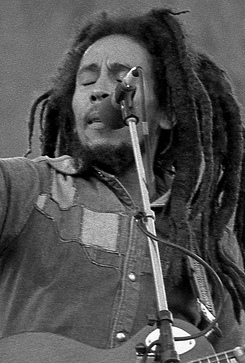
Listen to this February 5, 2020 flashback episode about Bob Marley, homeless at age 20 in one of the poorest cities of the Third World, he became a popular music phenomenon and 20th century icon.


Podcast: Play in new window | Download
Subscribe: RSS

Listen to this February 5, 2020 flashback episode about Bob Marley, homeless at age 20 in one of the poorest cities of the Third World, he became a popular music phenomenon and 20th century icon.
Podcast: Play in new window | Download
Subscribe: RSS
Homeless at age 19, in one of the poorest cities of the Third World, Bob Marley eventually created what Time Magazine called, “The greatest album of the Twentieth Century.

Robert Nesta Marley was born in Nine Mile, Jamaica on February 6, 1945 to Cedella Editha Malcolm and Norval Sinclair Marley. Marley’s mother, a Jamaican of African descent was 18 years old. His father, a Caucasian of British ancestry was 60. Although Norval Marley has been described as a sea captain, British army officer and even quartermaster he was in fact a laborer and construction worker who never saw military action. He lived and worked in Britain, Africa and the Caribbean and was employed as an overseer of the subdivision of the rural area around Nine Mile in the Jamaican province of St. Anne. At the time of Bob Marley’s birth, Nine Mile had neither electricity or running water.

Literally around the corner, on Third Street, a successful musician by the name of Joe Higgs routinely ran practice sessions with locals he deemed talented enough. There, Bob and Bunny met another aspiring crooner named Winston Hubert McIntosh, eventually known as Peter Tosh, and Higgs decided the trio had something special.


Finally, Bob Marley became so fed up with the situation that he decided that he would join his mother in Wilmington, Delaware. He hoped to find work and save enough money to bankroll the Wailers own production and recording efforts allowing the musicians to retain control over the profits. Before leaving, perhaps to reassure her, Bob made the decision to marry his longtime girlfriend, Rita. He promised to return and the official wedding on February 10, 1966 underlined his commitment.
Podcast: Play in new window | Download
Subscribe: RSS
18, unemployed and homeless in one of the poorest cities of the Third World, Bob Marley eventually created what Time Magazine called, “The greatest album of the Twentieth Century.”

Meanwhile, in 1974, he was attempting to reorganize the Wailers and decide on his next musical direction. He needed to replace the two most prominent departed, which he did with a trio of female backing vocalists that included his wife Rita, Marcia Griffiths and Judy Mowatt, dubbed as the I-Three.

Previously a dilapidated mansion in a posh Kingston neighborhood at 56 Hope Road, a house that Bob Marley eventually purchased outright. Marley’s wife Rita was domiciled at Bull Bay, ten miles outside of Kingston, with the couple’s four children, including a son Stephen, born on April 20, 1972. Marley spent much of his time at Hope Road pursuing various relatively open romantic relationships including one with Esther Anderson, a high profile employee of Island, as well as an actress and model who starred in several Hollywood feature films.

Podcast: Play in new window | Download
Subscribe: RSS
The books used during the composition of this podcast included:
Catch A Fire, by Timothy White
So Much Things To Say, by Roger Steffens
Bob Marley: A Life, by Gary Steckles
Bob Marley (Stories Behind the Songs)
The intro music to Part One and Two is: Thug Dub, by Quincas Moreira
The outro to Part One is: Feel Nice, by Rick Steel