All posts by Phil Gibbons

Marie Antoinette, Deadly Splendor (Part Two)

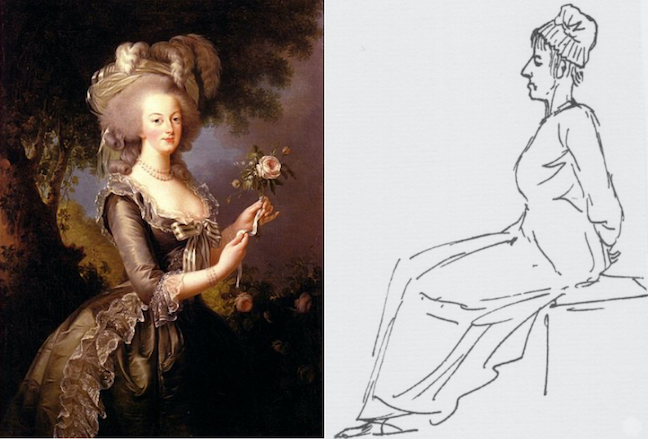
In 1770, the French people greeted Austrian Marie Antoinette as the beautiful and future French queen. Twenty-three years later they guillotined her as the most reviled woman in France.

The Comtesse de la Motte

The affair of the Diamond Necklace had its origin in a piece of jewelry that was commissioned by Louis XV in 1772 and meant as a gift for his mistress, the Madame Du Barry.  He requested that the royal jewelers Charles Boehmer and Paul Bassenge create a diamond necklace that exceeded anything previously produced.  On spec, the two men took great pains to assemble a creation that incorporated a great number of exquisite diamonds in a staggeringly large and ornate necklace.  Called, “The Slave’s Collar,” and consisting of over 2800 carats of diamonds, the worth of this necklace today has been estimated to be as high as one hundred million dollars.  Unfortunately, the King died before this accoutrement could be finalized, the jewelers now stuck with a very expensive piece of jewelry and an extremely small pool of potential buyers, the most obvious Louis XVI.  But twice, in 1778 and again in 1781, for one reason or another both the King and Marie Antoinette declined to purchase the necklace.  Unsold, this became the basis of an elaborate confidence scheme hatched by a socially and financially ambitious woman who called herself the Comtesse Jeanne de la Motte.

The Cardinal de Rohan

By late 1784, Jeanne had ingratiated herself as the mistress of the Cardinal de Rohan, not only a member of the powerful de Rohan noble family but a former diplomat deployed in Vienna to the court of Maria Theresa.  Unfortunately, his dissolute lifestyle and anti-Austrian bias earned him the antagonism of the Empress, who in turn delivered her opinion of the Cardinal to Marie Antoinette.  Upon Louis XVI assuming the throne, De Rohan, most likely upon the urging of the Queen, was hastily recalled.  Understanding that the Cardinal was desperate to improve his status within the French court, Jeanne de La Motte convinced De Rohan that she was well connected to especially Marie Antoinette.  In fact, through a forger, fellow huckster and also feigned aristocrat Armand Retaux de Villette, Jeanne was able to access the French Court.  She further convinced de Rohan that the Queen had officially acknowledged her and that Marie Antoinette held her in high esteem.  De Rohan then began what he thought was a correspondence with the Queen, receiving letters in return that were actually forged by Retaux de Villette.  Blinded by his ambition, De Rohan did not hesitate when Jeanne began asking for loans and even produced signed letters which requested that he help the Queen secretly acquire the, “Slave’s Collar,” to avoid public and even Louis XVI’s awareness of such an exorbitant purchase, an acquisition that might inflame hostility over royal expenditures even further.  To add further credibility to the scheme, De La Motte and Retaux de Villette staged a nocturnal, secret liaison between the Cardinal and a woman he thought was Marie Antoinette.  In fact, the two confederates hired a prostitute who resembled the queen, Nicole d’Oliva, the three arranging to meet the Cardinal in a remote corner of the gardens of Versailles.  In the darkness, d’Oliva, dressed fashionably, approached the Cardinal, handed him a rose and breathlessly intoned, “You know what this means, the past will be forgotten” before quickly and stealthily retreating.   

A zirconium replica of the Slave’s Collar

Convinced that he was on the verge of a great political restoration and even deluded enough to believe that Marie Antoinette was physically attracted to him, De Rohan now reached out to the jewelers, who were also blinded by their zeal to unload the necklace.  With, unbeknownst to him, forged letters in hand from the purported Marie Antoinette, requesting that the Cardinal act as her representative, a deal was negotiated whereby the necklace would be paid for in installments.  Of course, the transaction was to occur amidst the utmost secrecy, a condition De La Motte could not emphasize enough.  The necklace was secured by the Bishop, he then was instructed to turn it over to an individual described as a valet of the Queen, in fact Nicholas de la Motte, who hastily fled to London.  By the time the alleged count arrived in England, the diamonds had been pried out of their settings, many damaged during the process, but still able to be fenced. 

Louis XVII

Marie Antoinette’s son and heir, the dauphin Louis Charles, already considered by royalist emigres as the de facto Louis XVII, was treated just as brutally.  After his mother’s execution, he was placed in a solitary, damp cell, fed through the bars, with little interaction with his jailers.  He endured such conditions for sixth months, until a change in government allowed for the improvement of his confinement.  By then he had contracted tuberculosis, the ailment which killed him on June 8, 1795, aged ten years old. 

Louis XVIII

Louis XVI’s brother, the Comte de Provence was crowned Louis XVIII after Napoleon’s exile to Elba.  His reign interrupted by the one hundred days and Waterloo, he ruled until 1824.

Charles X

Louis XVI’s youngest brother as Charles X, a ruler so odious and reactionary that he prompted a second popular revolution, an event that caused his abdication. 

Marie, in mourning garb at the Temple

Back at the Temple, Marie Antoinette was not formally told of her husband’s death but the noise and tumult from the street down below told her and her family everything they needed to know.  From that day on, she received and wore black mourning clothes and descended into a hopeless depression.

Marie Antoinette in the Conciergerie

On July 3rd, Marie’s status took an ominous turn when she was informed by her jailers that she was to be separated from her son.  Additional Austrian victories now placed Paris in even greater danger.  As a result, at two o’clock in the morning on August 2, Marie Antoinette was transferred to the Conciergerie, a much more secure and foreboding courthouse and prison.   There was no attempt to spruce up her new environment or disguise its intent, the damp brick, bed, rudimentary chair and bucket toilet of a prison cell.  A hapless attempt by royal sympathizers within the prison known as the Carnation plot only served to tighten the security around Marie Antoinette.  From then on armed sentries remained in her cell, subdivided with a simple wooden screen which did little to protect Marie’s modesty.

Marie Antoinette, Deadly Splendor (Book and Music Information)

The books used in this podcast included:

“Marie Antoinette: The Journey,” by Antonia Fraser and

“Queen of Fashion,” by Caroline Weber.

The intro to both parts was, “A Baroque Letter,” by Aaron Kenny and

The outro to both parts was, “Surrender,” by Asher Fulero.

Crockett, Bowie and Travis, Defenders of the Alamo (Part One)

An enduring American legend, hear what actually happened at the Battle of the Alamo

David Crockett

By 1817, after emerging from the military, David situated his family in Lawrence County, Tennessee as one of the area’s first inhabitants.  Making a living as a professional hunter, mostly of wild bears, Crockett also began to involve himself in local politics, serving as a county commissioner and eventually as a state appointed justice of the peace.  He also served several terms in the state legislature and was eventually elected to the US House of Representatives in 1826.  He was re-elected to a second term in 1828 but ran into trouble when he emphatically opposed Andrew Jackson’s plans to relocate native Americans, an especially unpopular stance in Jackson’s home state of Tennessee.  Defeated for re-election in 1830, he was returned to Congress one more time in 1833.  It was during this time period that Crockett co-wrote an autobiography entitled, “A Narrative of the Life of David Crockett of the State of Tennessee,” an attempt to take advantage of popularity generated by an 1831 play entitled, “The Lion of the West,” about a larger than life pioneer named Nimrod Wildfire, but obviously fashioned after Crockett.  It was during his publicity tour promoting this book’s publication that a quote attributed to Crockett discussing his immediate political future appeared in numerous newspapers, “I told the people of my district that I would serve them as faithfully as I had done; but if not, they might go to hell, and I would go to Texas.”

Jim Bowie

Bowie became nationally famous after an incident that occurred on September 19, 1827 known as the Sandbar Fight. The conflict, essentially a violent, murderous brawl between two competing business and political entities competing over elected offices and business interests in Central Louisiana resulted after a duel that occurred on a sandbar situated on what was then neutral territory along the Mississippi River, near Natchez, Mississippi.  Initially two men, Samuel Wells and Dr Thomas H. Maddox, fought a formal duel that typically concluded with shots fired but no injuries.  While these two individuals seemed content to bury the hatchet, several other members of each contingent had a history of animosity and violent interaction.  A spontaneous gunfight broke out in which Jim Bowie was first wounded in the leg, sending him to his knees.  Bowie then got up and unsheathed the large hunting knife he always carried for protection and lunged after the individual who shot him, Robert Crain.  Bowie was knocked to the ground again when Crain hit him with the butt of his now empty pistol.  Norris Wright, an individual who had previously tried to shoot Bowie on another occasion, then fired an errant pistol shot and followed that up with a sword cane attempt to stab Bowie in the chest.  The thin blade apparently stuck in Bowie’s sternum, while he then mortally plunged his 9 by 1.5 inch knife into Wright’s mid-section, ripping upward.  Wright bled out quickly while other assailants continued to stab and shoot at Bowie, but he successfully fought off his attackers, suffering two bullet wounds and seven knife wounds, including the sword cane that was impaled in his chest.  In total, two men were killed, four injured, including Bowie who needed months to recuperate.News of this sensational episode spread initially through regional and then national newspapers, with the focus on Bowie, his outsized knife as well as aggrandizing tales of roping alligators on the bayou and similar exploits, transforming him into a frontiersman in the fashion of Daniel Boone.  Subsequently, business boomed in the production of Bowie styled knives and Bowie himself wore one, sheathed, for the rest of his life. 

William Travis

Smith then turned to the individual designated as officially responsible for recruiting soldiers into the newly elected provisional government’s army, William B. Travis, and ordered him to reinforce the garrison at San Antonio.  Travis was previously supposed to round up as many as one hundred men into a cavalry force, which he would lead as a lieutenant colonel.  Of the three most famous individuals killed at the Battle of the Alamo, Jim Bowie, David Crockett and William Travis, Travis was by far the most obscure at the time of the incident.  

Santa Anna

Fifteen years earlier, in 1821, a lengthy military insurgency was able to unofficially establish Mexico’s independence from Spain.  Although Spain sporadically attempted to reassert control over the country, all of these efforts ultimately failed.  However, the Mexican government and political situation remained both violent and unstable.  From this chaos emerged the general and warlord, Antonio Lopez de Santa Anna, a military figure who achieved national prominence for his role in defeating Spanish attempts to reclaim Mexico.  Santa Anna eventually consolidated political and military authority and in 1835, dissolved the Mexican constitution attempting to transform the Mexican government from a loosely autonomous group of Mexican states into an entity controlled by a federal government.  

General Urrea

While Santa Anna casually headed east toward what he believed would be an eventually similar destruction of both the Texian government in San Felipe, Texas and any remnants of a Texian army, Fannin was ordered by Sam Houston to abandon Goliad and head east towards Victoria, Texas.  He was pursued by another army commanded by General Jose de Urrea, which originated in Matamoros and was proceeding directly toward Goliad.  

A typical bowie style knife

By 1830, Bowie, hearing of land speculation opportunities in Texas, set out for the territory.  He formally introduced himself to such prominent locals as Stephen F. Austin and then, after taking an oath of allegiance to Mexico, began acquiring cheap land grants, ultimately setting in San Antonio de Bexar.  There he began romancing the nineteen year old daughter of Juan Martin Veramendi, the wealthiest businessman and politician in the region.  Bowie eventually married Ursula de Veramendi, went into business with his father in law and professed to be a wealthy and successful businessman in his own right, selling his holdings outside of Texas.  However, after his land sales in Arkansas were ruled fraudulent, he relied mostly on his relatives for both housing and living expenses.  Involving himself in the secessionist politics of the region, Bowie was a firm believer in creating a Texas independent from Mexico.

Crockett, Bowie and Travis, Defenders of the Alamo (Part Two)

An enduring American legend, hear what actually happened at the Battle of the Alamo.

James Fannin

Fannin’s typically sluggish retreat left him out in the open and resulted in a March 19 battle near Coleto Creek only a few miles east of Goliad.  Fannin’s men successfully repulsed repeated Mexican attacks but suffered many wounded troops that they could neither treat or transport.  The following morning, with another Mexican attack imminent, Fannin surrendered with Urrea only promising that he would try to intercede with Santa Anna to spare any prisoners, although most of the Texians, who in a written agreement were officially categorized as prisoners of war, believed that they were to be pardoned. 

Knife allegedly used by David Crockett at the Alamo

While even some Mexican accounts have David Crockett inflicting dozens of casualties, many with his bare hands and a rifle butt, several eyewitnesses claimed he was actually captured alive and subsequently executed with the half dozen defenders Santa Anna personally ordered killed only minutes after the battle’s conclusion.  Susannah Dickinson did say in several interviews that she saw Crockett’s mutilated body in the plaza, after the battle, his distinctive fur cap lying at his side.

Sam Houston as a US Senator

Sam Houston emerged as the leading political figure in Texas, winning election over Stephen F. Austin as President of the Republic of Texas and ultimately Houston was elected to the US Senate.  While loyal to the state of Texas, he personally opposed secession from the Union and died in 1863 before the end of the Civil War.  

San Jacinto Memorial column at the site of the battlefield

Charging out of wooded areas which concealed their initial advance, Houston’s troops, shouting Remember the Alamo and Remember Goliad inflicted a lopsided 18 minute victory, much of it spent massacring surprised and unarmed fleeing Mexican troops, over 600 killed and 700 taken prisoner.  Santa Anna escaped for the moment; he was caught the following day, hiding along the river bank dressed in a private’s uniform and slippers.  Only his value as the de facto ruler of the Mexico prevented his immediate execution. 

The Alamo today

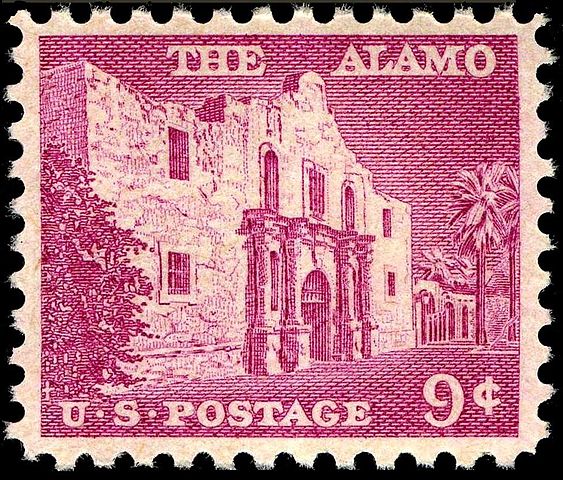
Today, most of the former Alamo complex has been swallowed up by downtown San Antonio.  The only remaining structures are the former mission chapel, familiar to most Americans and part of the Long Barrack, with two small courtyards in between.  However, the distinctive oval roof line over the front entrance of the chapel building was not added until 1849.  Initially, after the Texas revolution the military used the chapel as a warehouse, other parts of the complex were used by private interests for commercial purposes.  The chapel eventually reverted back to the Catholic Church who sold it to the state of Texas.  

Crockett, Bowie and Travis: Defenders of the Alamo (Book and Music Information)

The books used to compose this podcast included:

“Three Roads to the Alamo,” by William C. Davis and

“A Time to Stand: The Epic of the Alamo,” by Walter Lord.

The intro music for part one is, “Classic Mariachi,” by Jimena Contreras. The outro music for part one is, “The Last Goodby,” by Telecasted. The intro for part two is, “Cowboy Lullaby,” by JHS Pedals. The outro for part two is, “Si Seaorita,” by Chris Haugen

Elvis Presley’s Manager: Colonel Tom Parker (Part One)

The true story about the man who contributed mightily to the destruction of one of America’s greatest 20th century icons.

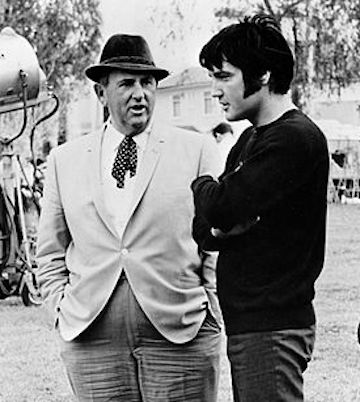
Elvis and the Colonel, on set.

According to Colonel Tom Parker personally, he was born in early 1900, in Huntington, West Virginia and began working in touring carnivals at a very young age.  He served in the military, eventually developed and promoted his own carnival acts and graduated to first promoting and then managing country musicians until obtaining the exclusive management contract of Elvis Presley in 1954.  While he was always able to obscure his true beginnings, his singular accent was ascribed to his origins in rural Appalachia.  In fact, although slight, his accent was Dutch because Colonel Tom Parker was not born anywhere near West Virginia, he was not even born in the United States.  He was born Andreas Van Kuijk on June 26, 1909, in Breda, The Netherlands, the seventh of eleven children of Maria and Adam Van Kuijk.

Elvis, Jailhouse Rock, 1968, NBC special

Initially conceived as a Christmas special by Tom Parker, both Elvis and the shows creative team of Steve Binder and Bones Howe agreed that they wanted a more stripped down return to Elvis’ musical roots and were able to convince Parker to generally accept moving away from Elvis singing Christmas carols, most likely because that was something Presley wanted no part of.  Once they got that general agreement, Elvis made the creative decisions on his own with a great deal of input from Binder whose perspective Presley respected.  The resulting special, with a tanned, refreshed Elvis in an especially remarkable leather outfit, among other wardrobes, performing an extended medley of some of his most popular or distinctive hits was the highest rated television show of the year, the program also a critical hit.

Graceland

With Elvis on the road and her husband engaging in various romantic adventures as a result of his newfound notoriety, Gladys Presley, already a heavy drinker, began to consume alcohol on a daily basis and abuse sleeping pills.  Quite domineering in her relationship with Vernon, it is believed as she deteriorated physically, her husband, in Elvis’ absence began to be much more physically abusive.  Her son’s fame was also troubling and overwhelming, her fear that an hysterical crowd might eventually harm or even kill Elvis.  Depressed because her neighbors disliked her habit of raising chickens and feeding them on the front lawn of Graceland, Gladys never really adjusted to her family’s radical transformation, once telling her friend, “I wish we had stayed poor.”

Elvis and Priscilla, shortly after the birth of his daughter.

While in Germany, Presley also met Priscilla Beaulieu, a fourteen year old daughter of an Air Force officer stationed in Wiesbaden, Germany.  Because of her youth, her relationship with Presley was extremely restrained until 1962, although her ability to then visit Elvis and ultimately live at Graceland while Priscilla attended a local Catholic High school, was conditional upon an agreement that the couple eventually marry.

Joe Esposito, circa 2010

Because some of the Memphis Mafia especially Joe Esposito, were conduits to the Colonel, he was fully aware of Preley’s restlessness and anger over his stalled career.  He also was mindful that at some point, Elvis’ public might completely tire of the formulaic nonsense that was now the mainstay of Elvis’ income stream.  He began discussions with NBC for a television special live performance that would be billed as Presley’s comeback as an entertainer.

Lamar Fike, circa 2005

Another close associate of Presley, Lamar Fike, was in Portland, Maine, also to help get ready for the tour.  He was attempting to get some sleep after taking a redeye from Los Angeles when there was a loud knock on his door, a voice telling him intently that the Colonel needed to see him right away, despite Fike’s protestations.  Entering the Colonel’s hotel room, he noticed other employees avoiding his gaze as Parker hung up the phone.  In an unemotional tone of voice, the Colonel explained that Fike needed to go to Memphis and be with Vernon Presley, Elvis’ father and that Elvis was dead.  Like many members of the entourage and even Elvis himself, Fike’s relationship with Parker at this point was at best, ambivalent, in Fike’s case, he frequently expressed concern over Elvis Presley’s physical condition.  Parker typically ignored such entreaties, maintaining whenever forcefully pressed on this concern “that the only thing that mattered was getting Elvis ready to appear on stage that night.”

Elvis Presley’s Manager: Colonel Tom Parker (Part Two)

The true story about the man who contributed mightily to the destruction of one of America’s greatest 20th century icons.

Elvis, Aloha From Hawaii

The Colonel, understanding that the lack of international touring was a major irritant for Elvis, then devised an ingenious plan to circumvent his personal abhorrence of such a tour.  He made a deal with various television networks all over the world for Elvis to appear in a live format for live international satellite transmission to countries including Hong Kong, Japan, South Korea, South Vietnam, the Phillippines and Australia.  Because the Super Bowl would take place on the same day, January 14, 1973 and because special attention and additional material was to be supplied for the version shown in the United States, the American edition of the show appeared on April 4.  Elvis became excited about this novel showcase, lost twenty-five pounds in the month leading up to the show and also cut way back on his pharmaceutical consumption, evident when he hit the stage in a specially designed American eagle jumpsuit, this preparation helping to produce an iconic appearance.  The show was again NBC’s highest rated program of the year and the subsequent release of a live double album sold a half million copies in two weeks, startling numbers in the age of vinyl.

Linda Thompson in 2018

Linda Thompson, the Tennessee beauty queen that became Elvis’ official girlfriend after his marriage dissolved, hoped that Presley’s ability to get himself into some semblance of normal sober shape might be a permanent transition.  But only hours after the concert ended in the early morning, Presley was again so narcotically intoxicated he could not even get off of his hotel room balcony to accompany his entourage to the USS Arizona memorial.  Thompson herself would personally witness Presley’s final harrowing descent and bizarre behavior that transformed him into a tragic monstrosity.

The four engine jet that flew Elvis’ entourage across America.

Despite his resurgence, Elvis Presley’s spending habits, large payroll and maintenance of both Graceland and a succession of households in Bel-Air and Beverly Hills necessitated a great deal of cash.  While his live shows were lucrative, they entailed transportation eventually aboard a Convair 880 four engine jet, named the Lisa Marie after his only daughter, which transported a large entourage of security and band members to most shows.

The Las Vegas Hilton

With financial necessity having forced Kirk Kekorian to sell the International to the Hilton Hotel Corporation, Presley spent his time at what was now the Las Vegas Hilton, isolated In his hotel suite, avoiding Colonel Parker, who he rarely spoke to, Parker spending most of his time at the gaming tables running up a debt that eventually reached thirty million dollars.  Stories of Presley spontaneously shooting out television sets and streetlights were absolutely true, the paranoid singer usually armed with several handguns, once coming within inches of accidentally shooting Linda Thompson while she was using the bathroom.

Elvis, Rapid City, South Dakota, only weeks before his death.

By August of 1977, Elvis Presley, 6 feet tall, weighed 350 pounds, 175 pounds more than what he weighed only four and a half years earlier during his Aloha from Hawaii concert.  His heart was three times its normal size and his nervous system routinely  contained as many as twelve separate types of mostly narcotic medication, including several types of opiates.  His remarkable tolerance of these medications was the product of massive abuse that stretched back over two decades.

Colonel Parker on Nightline, interview plugging an Elvis convention years after Elvis’ death

Following the circuslike funeral and public outpouring of grief after Elvis Presley’s death, life went on normally for Colonel Parker and Presley’s immediate family.  A year later, a convention was held at the Las Vegas Hilton, organized by Tom Parker, that included a dedication of a statue of Elvis in the lobby, separate admission to an Elvis re-creation for a fifteen dollar additional charge, appearances by Priscilla and Vernon Presley, and the Colonel signing an autographed poem for a buck a throw. Over a million dollars came in in 1978 for merchandise profits at least half paid to Parker.

Elvis Presley’s Manager: Colonel Tom Parker (Book and Music Information)

The books used in this podcast included:

“The Colonel: The Extraordinary Story of Colonel Tom Parker and Elvis Presley,” by Alanna Nash.

“Careless Love, the Unmaking of Elvis Presley,” by Peter Guralnick.

“Elvis Aaron Presley: Revelations From the Memphis Mafia,” by Alanna Nash.

The music used in this podcast included:

“The Goon’s Loose,” by Nathan Moore, Part One and Part Two intros.

“Summer Solstice on the June Planet,” by Bail Bonds, Part One and Part Two, outros.

The Untold Story of Crime Boss and Sixteen-Year Federal Fugitive, James (Whitey) Bulger (Part One)

For twenty years, Whitey Bulger terrorized Boston with the full collusion of the FBI.  On the run for sixteen years, he was eventually arrested on June 22, 2011.

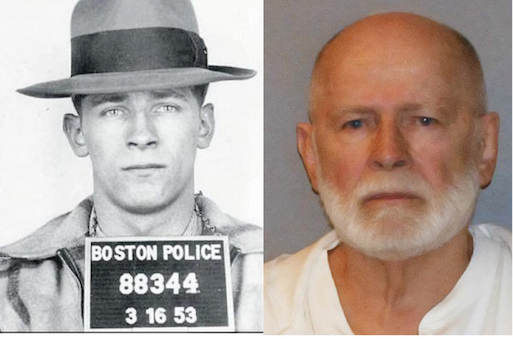
Whitey, mug shot, early fifties.

Between the ages of thirteen and eighteen Bulger was arrested ten times, for crimes ranging from larceny, drunk in public and assault and battery.  Only once were charges ever pursued to the point of a criminal conviction and even then, Whitey was able to get the charge reduced on appeal.  It is no wonder that he developed an arrogant disdain for the criminal justice system and a sense of invulnerability.  Unfortunately, this mentality only increased the severity of his transgressions.  In May of 1948, Bulger and two accomplices enticed a young female into Whitey’s car and attempted to rape her at a beach in Dorchester.  The girl fought back and was kicked to the curb, but not before getting the license plate.  All three teens were quickly arrested.  Again, Bulger plead guilty to a lesser assault charge, paid a fine and avoided a serious prison term.  Within two months, he was arrested again, this time for a drunken assault in a diner that turned into a brawl with the police who showed up to arrest him.  Again, he plead guilty to the lesser charge of public drunkenness, paid a modest fine and walked away.

Whitey, Alcatraz mug shot

Despite Bill Bulger’s vehement and relentless involvement, including an eleventh hour visit to DC to the Director’s office for an unscheduled, in person request for a last minute reprieve, on November 13, 1959, Whitey was flown commercial, with federal marshals, from Baltimore to San Francisco.  From there, in leg irons, he was placed on the small ship that transported him to the center of San Francisco Bay and the Rock.  This was an especially isolating development for Whitey for in the late fifties transcontinental flight was a luxury the Bulger family certainly could not afford.  He would have to rely on letters only, the occasional visit from his brother or other family members now an impossibility.

John Martorano

On May 27, 1981. In broad daylight, at a country club in Tulsa, Martorano followed Roger Wheeler to his car in the parking lot and as Wheeler got in Martorano pulled the door open, put a bullet right between Wheeler’s eyes and hopped into a getaway car driven by another Winter Hill mobster.  Tulsa investigators quickly determined that criminals from Boston were probably involved, but when they and Oklahoma City FBI agents contacted Boston FBI, they got nowhere.

Kevin Weeks

Gradually, even the highest level coke and pot dealers were invited to the upstairs office of the Triple O’s Bar.  There, Whitey would be waiting, usually with at least Kevin Weeks, a former bouncer that Whitey took under his wing, gradually relying on him as one of his top enforcers.

Whitey, Atlanta mug shot

In July of 1956, there was no cushy Club Fed where Whitey could serve out his time in relative penal comfort.  Instead, he was sent to the Federal Penitentiary in Atlanta, a huge, forbidding edifice that had housed the likes of Al Capone, Mickey Cohen and Vito Genovese.  By comparison Whitey Bulger was a two-bit, bank robber, not exactly intimidating at 5’10”, 150 pounds and other than a few hoodlums back in Boston not particularly well connected.  After thirty days of quarantine that was mandatory for every new inmate, Bulger was assigned to one of the eight man cells that comprised most of the tiers of the prison.

The Triple O’s Lounge, today it is an upscale Italian restaurant

Although Bulger had shot some gangster rivals to death in his early battles with the Mullens, his hands on violence began to ramp up in the late seventies, probably as a result of his newfound power as the most powerful criminal in South Boston.  This attitude was evidenced in the matter of Louie Latif, a bookmaker and drug dealer who began to behave erratically, first by murdering several business associates who caught him stealing and then by dealing cocaine.  Both behaviors were not only repeatedly unsanctioned by Bulger, Litif also refused to pay rent.  Summoned to the upstairs office at Triple O’s, Litif was pointedly warned that he was crossing a very serious line.  Litif responded that as long as he and Whitey were friends, he didn’t have a problem.  Bulger fixed him with what must have been a terrifying stare and responded, “We’re not friends anymore.”

The Untold Story of Crime Boss and Sixteen-Year Federal Fugitive, James (Whitey) Bulger (Part Two)

For twenty years, Whitey Bulger terrorized Boston with the full collusion of the FBI.  On the run for sixteen years, he was eventually arrested on June 22, 2011.

Louis Litif, murder victim

Litif got off with this stern warning but then made the mistake of telling Bulger that he was going to murder his bookmaker partner, a last straw.  On April, he was invited to the Triple O’s where Bulger stabbed him repeatedly with an ice pick and Steve Flemmi shot him in the head.  His body was found in the trunk of his car, in garbage bags, abandoned on a South End street.  In another example of his macabre sense of humor Whitey explained to associates afterwards that Litif, known as a flashy dresser, was wearing green underwear after they stripped his body.  Therefore, they made sure that they used green garbage bags, so that Louis would be found, color coordinated.

Brian Halloran, murder victim

Only a few months later, a Southie criminal named Brian Halloran tried to extricate himself from some serious criminal charges by going to the FBI, with details tying Bulger and Flemmi to the murders of Louie Litif and Roger Wheeler, even claiming to be an eye witness in both cases.  Although Halloran was at least embellishing if not outright lying about his presence at the Wheeler slaying, he was close enough to Callahan to be able to secretly record potentially incriminating conversations. He pleaded to be allowed into the witness protection program and the agent handling his case figured he would run that by supervisor John Morris, to see what he thought. Morris immediately told Connolly who told Whitey Bulger.

The Haunty, 799 3rd Street, South Boston

With two bodies now buried in its basement, Whitey Bulger began referring to the Nee house as the Haunty.  The cellar would have another permanent guest, Deborah Hussey, Steve Flemmi’s quasi-stepdaughter.  Although he and Marion Hussey never married, he lived within the Hussey household and was perceived as the father in the family.  That is, until Deborah Hussey revealed that Flemmi had molested her sexually, beginning when she was a young teenager.  As an adult, Debbie developed a serious drug addiction and resorted to prostitution to feed her habit.  Arrested on numerous occasions, she frequently named dropped both Flemmi and Bulger to the police.  She also took to hanging around the Triple O’s and demanding drinks from the customers or hitting up Southie dope dealers for freebies, bragging that she had connections to Whitey, another big red flag.  Bulger believed her to be a dangerous loose cannon and began pushing Flemmi to do something about it.  In early January, 1985, Flemmi did.  He got her to meet him by feigning guilt over what had happened between them and the general situation with her mother.  He asked to make it up to her by taking her clothes shopping and telling her he was thinking of buying her her own place.  Why don’t we drop by and take a look and see if you like it?  The house in question was The Haunty.

FBI agent John Connolly

Ambitious, Connolly was fully aware that for the FBI, the American Mafia to the exclusion of all other organized crime entities was the paramount target of Federal law enforcement.  Aware that Steve Flemmi already had provided information, Connolly set his sights on forming the same relationship with Whitey Bulger.  Thus far in his brief FBI career in New York, Connolly received high praise during his ongoing evaluations with the stipulation that he had not developed any confidential informants.  The agent, knowing Whitey from the old neighborhood and willing to cut ethical and professional corners, understood that developing Whitey as a Top echelon informant could be, within the bureau, a career maker.

FBI Supervisor John Morris

In the cat and mouse game of criminal informant, it quickly became clear that the lines were being blurred as to who was the cat and who was the mouse.  John Connolly introduced Bulger and Flemmi to his newly installed supervisor within the FBI’s Boston Organized Crime Unit, John Morris.  Connolly also arranged for regular dinners at Morris’ home in Lexington, Mass, dinners that included Whitey showing up with cases of very expensive wine, that always got left behind.  Morris was blown away by Connolly’s ability to gain access to two such high level informants and was also manipulated by Whitey’s slick Robin Hood façade of claiming to abhor drugs, detesting the Mafia and keeping his neighborhood free from hard drugs like cocaine and heroin and the junkies and pushers who came with such pestilence.  All of these claims were either ultimately self-serving or outright lies, but Morris was taken in.

Whitey’s apartment building, Santa Monica, his apartment was the last apartment, 3rd floor, all the way to the right.

In the late afternoon of June 22, 2011, in Santa Monica, California a property manager name Josh Bond was sitting in his office at the Embassy Hotel.  Picking up the phone, Bond punched in the number of tenants from another property across the street, the Princess Eugenia Apartments at 1012 3rd Street, only blocks from the Pacific Ocean.

Steve Flemmi, government witness

Whitey also made the most crucial connection of his criminal career when he began to interact with Stephen Flemmi, a member of the Winter Hill Gang who had ambitions of bigger and better things.  Nicknamed “The Rifleman,” based on two Army tours of duty in Korea, in which he earned both a Bronze and Silver Star, Flemmi also had an ongoing relationship with longtime Boston FBI agent Paul Rico who specialized in developing informants in the New England criminal underworld.